
Skip to content
Home page - Centenary Institute Centenary Institute

Primary menu

  • Research
        • Research

          The latest medical research into our most complex health challenges across biomedical AI, cancer, cardiovascular diseases, immunity, age-related, rare and infectious diseases.

          Learn more

        • Biomedical AI
        • Cancer Innovations
        • Cardiovascular Research
        • Healthy Ageing
        • Infection & Immunity
        • Rare Diseases & Gene Therapy
        • Laboratories
        • Impact
        • Technologies
        • Commercialisation
  • Support us
        • Support us

          By supporting the Centenary Institute you can help improve human health through excellence in medical research.

          Learn more

        • Workplace giving
        • Host or join a fundraiser
        • Gift in your will
        • Donate in memory
        • Advise on our research
  • Careers & students
        • Careers & Students

          Postdoctoral and postgraduate students can work alongside world-leading medical researchers within state-of-the-art research facilities.

        • Careers
        • Study opportunities
  • News & events
        • News & Events

          Explore the latest research breakthroughs and ways you can take part in our series of digital and in-person events.

        • News
        • Statements
        • Events
        • Real stories
  • About us
        • About us

          We are world-leading independent medical research institute that drives collaboration to accelerate and translate solutions to our most complex health challenges.

          Learn more

        • Governance
        • Corporate information
        • Annual reports
        • Animals in research
        • Contact
  • Donate
    Centenary Institute > News > New enzyme a target for cancer treatment

New enzyme a target for cancer treatment

Date time 14 July, 2015

Researchers at the Centenary Institute in Sydney have uncovered new information about an enzyme called DPP9 that they believe to be a potential therapeutic target for limiting tumour growth and its ability to spread to and in the liver.

Centenary’s researchers have shown that the DPP9 enzyme can regulate human liver cancer cell growth and movement. In addition, they have bred mice that lack DPP9 and shown that newborn mice need the enzyme to survive, highlighting its importance.

The results have shown that up to 100 molecules in the human body are probably de-­‐activated by DPP9 and many of these play important roles in either immunity or in regulating energy use and storage. The power of this enzyme is so great that it needs to be regulated. The aim of the next phase of the research is to discover how the cells of the body achieve this naturally.

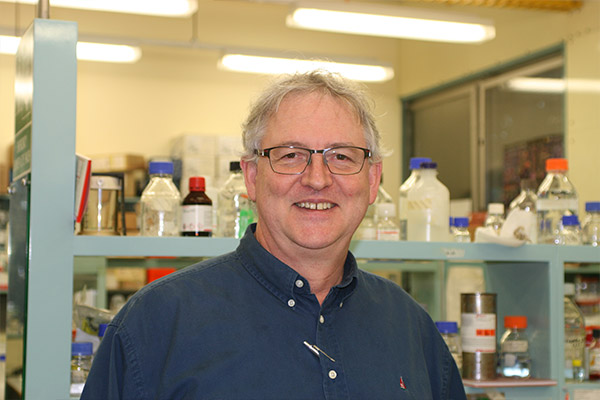
Associate Professor Mark Gorrell, who discovered DPP9, is currently undertaking an extensive study of the enzyme and its functionalities. He and his team are aiming to discover what key molecules are deactivated by DPP9 and therefore how to exploit the enzyme’s functionalities for clinical use. The research could lead to major breakthroughs in the treatment of cancer, as well as in understanding the immune system and growth of stem cells.

The team is following the same strategic approach that led to the discovery of the functions of a similar enzyme, DPP4, the most successful new diabetes drug target this century and the safest. By focusing on the mechanisms of the enzyme from a basic biochemistry perspective, they are developing an understanding of how it acts inside both normal cells and cancer cells.

The work to date has recently been published in the highly prestigious FEBS Journal, the leading journal of the Federation of European Biochemists.

This paper itself is a close collaboration with Dr Andrew Stephens and his staff at Hudson Institute of Medical Research at Monash University as well as involving Dr Ruth Geiss-Friedlander of Georg-­August-­University in Germany. Associate Professor Gorrell’s team includes talented PhD Students Katerina Ajami, Denise Ming Tse Yu, JooHong Park, Tsun-­Wen Yao, Yiqian Chen, Hui Emma Zhang and Margaret Gall who have all played key roles in the results achieved.

For further information about the Centenary Institute’s Molecular Hepatology Laboratory click here.

Media enquires

For all media and interview enquiries, please contact Tony Crawshaw

Phone number Phone Number +61 402 770 403

Email Email t.crawshaw@centenary.org.au

Recent Stories

  • Vaxosome launched to develop next-generation mRNA vaccines

    A new biotechnology company, Vaxosome, has been launched to develop next-generation vaccines aimed at tackling some of the world’s most challenging infectious diseases.
    News Type: Research News
    Date 10 Mar 2026
  • Centenary partners in transformative national liver health program

    The Snow Medical Research Foundation has today announced major long-term funding of $15.5 million for a new national research program targeting fatty liver disease, a condition that affects up to one in three Australians. The Centenary Institute will play a key role in the collaborative effort.
    News Type: Research News
    Date 05 Mar 2026
  • Centenary exhibition brings medical research to life in hospital spaces

    The Centenary Institute’s 'When Art Meets Science' exhibition took centre stage at the recent launch of the annual Sydney Local Health District (SLHD) March Arts program.
    News Type: Community
    Date 04 Mar 2026
  • ‘Mini hearts’ show COVID-19 virus directly infects heart tissue

    Researchers from the Centenary Institute and the University of Technology Sydney (UTS) have developed a human heart cell model demonstrating that the virus that causes COVID‑19 (SARS-CoV-2) can directly infect heart tissue, providing new insight into why some people experience serious heart complications during and after infection.
    News Type: Media release
    Date 03 Mar 2026

Subscribe to receive news on
research updates and free events

Newsletter

The Centenary Institute is a world-leading independent Medical Research Institute.

We acknowledge the Gadigal of the Eora Nation, the traditional custodians of the Country on which the Centenary Institute stands.

About

  • About us
  • Governance
  • Corporate information

Research

  • Our researchers
  • News

Careers & studies

  • Career opportunities
  • Student opportunities
  • Life at Centenary

Links

  • Contact
  • Privacy statement
  • Staff Intranet

Contact us

Building 93, Royal Prince Alfred Hospital
Missenden Rd
Camperdown NSW 2050 Australia
Telephone +61 2 9565 6100
Fax +61 2 9565 6101

Contact Privacy

Centenary Institute ABN 22 654 201 090 (DGR 1) • Centenary Institute Medical Research Foundation ABN 85 778 244 012 (DGR 2)
© 2017 Centenary Institute of Cancer Medicine and Cell Biology.

  • Linkedin
  • Facebook
  • Twitter
  • Youtube
  • Instagram