Skip to content
Home page - Centenary Institute Centenary Institute

Primary menu

  • Research
        • Research

          The latest medical research into our most complex health challenges across biomedical AI, cancer, cardiovascular diseases, immunity, age-related, rare and infectious diseases.

          Learn more

        • Biomedical AI
        • Cancer Innovations
        • Cardiovascular Research
        • Infection & Immunity
        • Rare Diseases & Gene Therapy
        • Laboratories
        • Impact
        • Technologies
        • Commercialisation
  • Support us
        • Support us

          By supporting the Centenary Institute you can help improve human health through excellence in medical research.

          Learn more

        • Workplace giving
        • Host or join a fundraiser
        • Gift in your will
        • Donate in memory
        • Advise on our research
  • Careers & students
        • Careers & Students

          Postdoctoral and postgraduate students can work alongside world-leading medical researchers within state-of-the-art research facilities.

        • Careers
        • Study opportunities
  • News & events
        • News & Events

          Explore the latest research breakthroughs and ways you can take part in our series of digital and in-person events.

        • News
        • Statements
        • Events
        • Real stories
  • About us
        • About us

          We are world-leading independent medical research institute that drives collaboration to accelerate and translate solutions to our most complex health challenges.

          Learn more

        • Governance
        • Corporate information
        • Annual reports
        • Animals in research
        • Contact
  • Donate
    Centenary Institute > News > New discovery to aid treatment of problem infant hemangiomas

New discovery to aid treatment of problem infant hemangiomas

Date time 23 December, 2021
News Type News type Media release
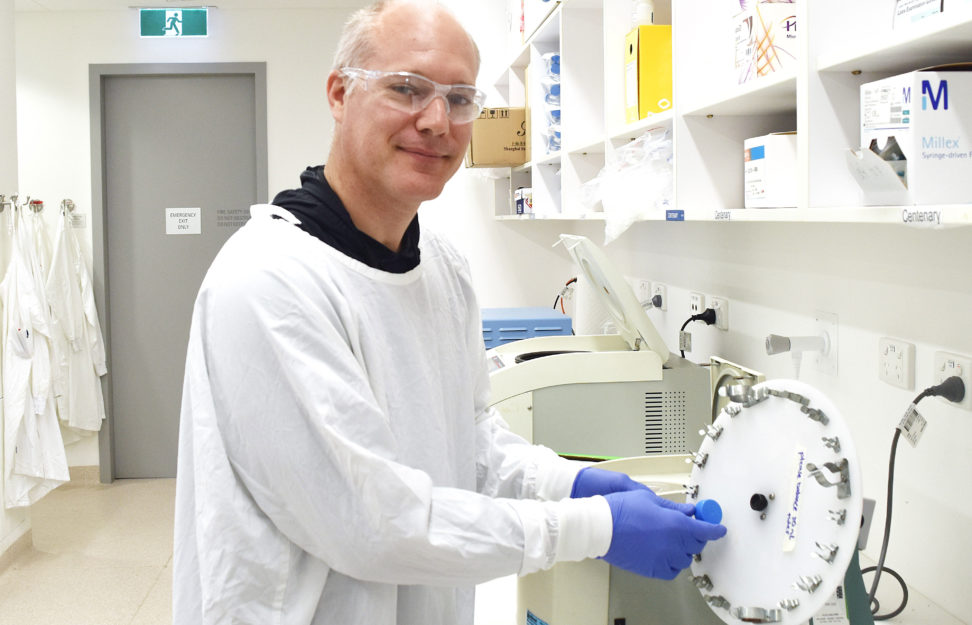
A/Prof Mathias Francois
Research led by the Centenary Institute and the Harvard Medical School, Boston, shows that a compound present in current beta blocker treatments could be repurposed to increase efficiency and safety of infantile hemangioma therapies.

Infantile hemangioma, a type of birthmark that occurs when a cluster of blood vessels grows in or under a baby’s skin, usually resolves on its own after a few years. However, infantile hemangiomas can cause complications such as airway or visual obstruction, cardiac failure, feeding difficulties, ulceration and disfigurement.

Propranolol and atenolol, both beta blockers, are commonly used as the mainstay treatment for infantile hemangiomas, shrinking the aberrant blood vessels but the treatment is not effective for around 20% of patients. Further, the molecular mode of action of the treatment is not fully understood by researchers.

For over 60 years propranolol has been given to humans as a beta blocker, mostly to manage blood pressure issues. Amazingly, this drug exists as a 50/50 mixture of two forms of the same molecule: the R and S enantiomers. Solely, the S-enantiomer is known to act as a beta blocker while the R-enantiomer has been considered as a by-product of chemistry synthesis with low to no biological activity.

In a new study, published in The Journal of Clinical Investigation, scientists discovered that R(+) enantiomers were able to inhibit infantile hemangioma blood vessels in pre-clinical models via targeting a molecular switch that is essential to gene expression of the vasculature during development. In particular, R-enantiomer blocks the activity of a protein named SOX18 which is essential to the transition from hemangioma stem cell to hemangioma endothelial cells.

The Centenary Institute’s Associate Professor Mathias Francois, senior author of the study and Head of the David Richmond Laboratory for Cardiovascular Development said that they had used a combination of pre-clinical mouse models of hemangioma based on patient derived hemangioma stem cells, together with advanced molecular imaging techniques to make their discovery. In particular the use of single molecule imaging in real time enabled the research team to firmly establish that R-enantiomer of propranolol directly engaged with the SOX18 protein.

“Approximately twenty percent of infantile hemangioma patients do not respond to current beta blocker treatments. Also, many patients suffer from beta blocker side effects including sleep disorders, bronchospasm, bradycardia, hypotension and hypoglycaemia,” Associate Professor Francois said.

“We believe that R(+) enantiomers, the ‘active ingredient’ in beta blockers inhibiting sick blood vessels, could  be further developed to increase the efficiency of infantile hemangioma treatments. Such an approach would also negate side effects resulting from current beta blocker use.”

Associate Professor Francois says the finding has the potential to reposition the clinical management of this disease and will provide non-responder patients with a new therapeutic option.

The research team hope to be able to validate their findings in the clinic with hemangioma patients as a next step.
Themes

  • Cardiovascular Research

    Cardiovascular Research

Media enquires

For all media and interview enquiries, please contact Tony Crawshaw

Phone number Phone Number +61 402 770 403

Email Email t.crawshaw@centenary.org.au

Media Release

New discovery to aid treatment of problem infant hemangiomas

Download

Recent Stories

  • New grant targets longer-lasting islet cell treatments for type 1 diabetes

    Dr Lise Hunault, a researcher in the Centenary Institute’s Centre for Biomedical AI, has been awarded a major research grant from Breakthrough T1D, the leading global type 1 diabetes research and advocacy organisation, to advance islet-cell replacement therapies for type 1 diabetes.
    News Type: Research News
    Date 16 Mar 2026
  • Centenary marks International Women’s Day with inspiring speakers

    The Centenary Institute community came together to celebrate International Women’s Day 2026, with a special event highlighting this year’s Australian theme, ‘Balancing the Scales.’
    News Type: Community
    Date 11 Mar 2026
  • Vaxosome launched to develop next-generation mRNA vaccines

    A new biotechnology company, Vaxosome, has been launched to develop next-generation vaccines aimed at tackling some of the world’s most challenging infectious diseases.
    News Type: Research News
    Date 10 Mar 2026
  • Centenary partners in transformative national liver health program

    The Snow Medical Research Foundation has today announced major long-term funding of $15.5 million for a new national research program targeting fatty liver disease, a condition that affects up to one in three Australians. The Centenary Institute will play a key role in the collaborative effort.
    News Type: Research News
    Date 05 Mar 2026

Subscribe to receive news on
research updates and free events

Newsletter

The Centenary Institute is a world-leading independent Medical Research Institute.

We acknowledge the Gadigal of the Eora Nation, the traditional custodians of the Country on which the Centenary Institute stands.

About

  • About us
  • Governance
  • Corporate information

Research

  • Our researchers
  • News

Careers & studies

  • Career opportunities
  • Student opportunities
  • Life at Centenary

Links

  • Contact
  • Privacy statement
  • Staff Intranet

Contact us

Building 93, Royal Prince Alfred Hospital
Missenden Rd
Camperdown NSW 2050 Australia
Telephone +61 2 9565 6100
Fax +61 2 9565 6101

Contact Privacy

Centenary Institute ABN 22 654 201 090 (DGR 1) • Centenary Institute Medical Research Foundation ABN 85 778 244 012 (DGR 2)
© 2017 Centenary Institute of Cancer Medicine and Cell Biology.

  • Linkedin
  • Facebook
  • Twitter
  • Youtube
  • Instagram