Skip to content
Home page - Centenary Institute Centenary Institute

Primary menu

  • Research
        • Research

          The latest medical research into our most complex health challenges across biomedical AI, cancer, cardiovascular diseases, immunity, age-related, rare and infectious diseases.

          Learn more

        • Biomedical AI
        • Cancer Innovations
        • Cardiovascular Research
        • Healthy Ageing
        • Infection & Immunity
        • Rare Diseases & Gene Therapy
        • Laboratories
        • Impact
        • Technologies
        • Commercialisation
  • Support us
        • Support us

          By supporting the Centenary Institute you can help improve human health through excellence in medical research.

          Learn more

        • Workplace giving
        • Host or join a fundraiser
        • Gift in your will
        • Donate in memory
        • Advise on our research
  • Careers & students
        • Careers & Students

          Postdoctoral and postgraduate students can work alongside world-leading medical researchers within state-of-the-art research facilities.

        • Careers
        • Study opportunities
  • News & events
        • News & Events

          Explore the latest research breakthroughs and ways you can take part in our series of digital and in-person events.

        • News
        • Statements
        • Events
        • Real stories
  • About us
        • About us

          We are world-leading independent medical research institute that drives collaboration to accelerate and translate solutions to our most complex health challenges.

          Learn more

        • Governance
        • Corporate information
        • Annual reports
        • Animals in research
        • Contact
  • Donate
    Centenary Institute > News > New treatment offers hope for advanced liver cancer

New treatment offers hope for advanced liver cancer

Date time 26 September, 2023
News Type News type Media release
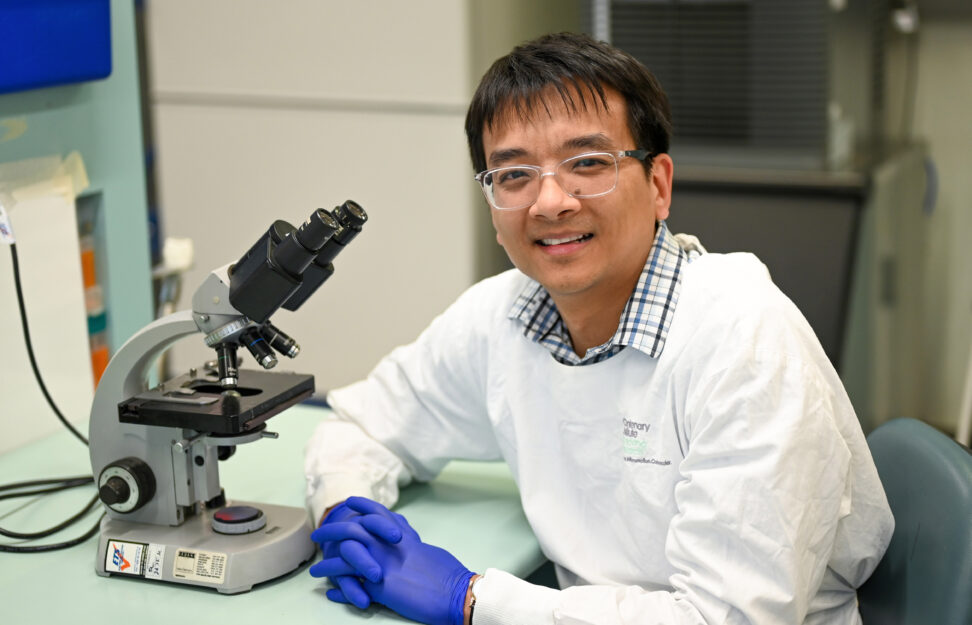
Dr Ken Liu
Researchers have discovered a new way to treat hepatocellular carcinoma (HCC), the most common type of liver cancer and the third leading cause of cancer death worldwide.

The Centenary Institute led study revealed an encouraging treatment strategy involving the use of a new drug called Blockmir CD5-2, combined with a drug called programmed cell death protein 1 antibody (anti-PD1 antibody). This combination proved effective in reducing liver tumour size in mice.

Lead author of the study, Dr Ken Liu, a researcher in the Centenary Institute’s Centre for Cancer Innovations said the discovery was exciting and had the potential to be a viable treatment for advanced liver cancer.  

“The synergistic effect of the drugs Blockmir CD5-2 and anti-PD1 antibody significantly reduced the size of liver tumours in mice in our study. We believe that this dual-drug approach enhances the immune system, rendering it more efficient in combatting cancer cells and reducing tumours,” said Dr Liu.

Dr Liu explained that liver tumours often have abnormal blood vessels and low oxygen levels, creating an environment that suppresses the immune system and the body’s ability to fight cancer.

“Blockmir CD5-2 addresses this issue by promoting the health of tumour blood vessels through the activation of a protein called VE-Cadherin. This results in improved blood supply and oxygen levels within the tumours,” said Dr Liu.

“The enhanced blood vessel conditions within the tumours means that more cancer-targeting immune cells, specifically cytotoxic T cells, can infiltrate the tumour and effectively combat the disease,” he said.

The researchers said that use of the anti-PD1 antibody was also a crucial component of the innovative treatment approach, helping the immune system fight cancer more effectively by blocking a protein that hinders the immune response.

Senior study authors, Professor Jennifer Gamble from the Centenary Institute’s Centre for Healthy Ageing and Professor Geoff McCaughan from the Centenary Institute’s Centre for Cancer Innovations said that current effective treatment options for liver cancer were limited and that the new therapeutic approach held tremendous potential for effectively treating such a challenging disease.

The research was published in the journal Frontiers in Immunology.

Publication:
Novel miRNA-based drug CD5-2 reduces liver tumour growth in diethylnitrosamine (DEN)-treated mice by normalising tumour vasculature and altering immune infiltrate.

Themes

  • Cancer Innovations

    Cancer Innovations

Media enquires

For all media and interview enquiries, please contact Tony Crawshaw

Phone number Phone Number +61 402 770 403

Email Email t.crawshaw@centenary.org.au

Media Release

New treatment offers hope for advanced liver cancer

Download

Recent Stories

  • Centenary marks International Women’s Day with inspiring speakers

    The Centenary Institute community came together to celebrate International Women’s Day 2026, with a special event highlighting this year’s Australian theme, ‘Balancing the Scales.’
    News Type: Community
    Date 11 Mar 2026
  • Vaxosome launched to develop next-generation mRNA vaccines

    A new biotechnology company, Vaxosome, has been launched to develop next-generation vaccines aimed at tackling some of the world’s most challenging infectious diseases.
    News Type: Research News
    Date 10 Mar 2026
  • Centenary partners in transformative national liver health program

    The Snow Medical Research Foundation has today announced major long-term funding of $15.5 million for a new national research program targeting fatty liver disease, a condition that affects up to one in three Australians. The Centenary Institute will play a key role in the collaborative effort.
    News Type: Research News
    Date 05 Mar 2026
  • Centenary exhibition brings medical research to life in hospital spaces

    The Centenary Institute’s 'When Art Meets Science' exhibition took centre stage at the recent launch of the annual Sydney Local Health District (SLHD) March Arts program.
    News Type: Community
    Date 04 Mar 2026

Subscribe to receive news on
research updates and free events

Newsletter

The Centenary Institute is a world-leading independent Medical Research Institute.

We acknowledge the Gadigal of the Eora Nation, the traditional custodians of the Country on which the Centenary Institute stands.

About

  • About us
  • Governance
  • Corporate information

Research

  • Our researchers
  • News

Careers & studies

  • Career opportunities
  • Student opportunities
  • Life at Centenary

Links

  • Contact
  • Privacy statement
  • Staff Intranet

Contact us

Building 93, Royal Prince Alfred Hospital
Missenden Rd
Camperdown NSW 2050 Australia
Telephone +61 2 9565 6100
Fax +61 2 9565 6101

Contact Privacy

Centenary Institute ABN 22 654 201 090 (DGR 1) • Centenary Institute Medical Research Foundation ABN 85 778 244 012 (DGR 2)
© 2017 Centenary Institute of Cancer Medicine and Cell Biology.

  • Linkedin
  • Facebook
  • Twitter
  • Youtube
  • Instagram