

Hogg Laboratory
Investigating how proteins work in health and disease.

Proteins are responsible for all of life’s processes and their structure is defined by two main types of covalent bonds: the peptide bonds that link the amino acid residues and disulfide bonds that link pairs of cysteine amino acids. Since the identification of disulfide bonds in the early 1960’s they were long thought to be fully formed and inert in the mature protein.
The Hogg Lab has shown that disulfide bonds are neither fully formed nor inert in proteins. Many proteins are constitutively produced and function as an array of partially disulfide-bonded states, and a subset of the formed disulfides – the allosteric disulfides – are cleaved by different factors to control mature protein function.
Disulfide bond regulation of protein function is being observed across biological systems and lifeforms. The Hogg Lab focuses on elucidating disulfide bond control of blood clotting and autoimmunity.



-
Biochemistry
-
Thrombosis and haemostasis
-
New diagnostics and therapies for cancer
- Protein chemistry
- Cell biology
- Medical imaging
- Disulfide bonds as switches for protein function
- Allosteric Disulfide Bonds
- Phosphoglycerate kinase acts in tumour angiogenesis as a disulphide reductase
- A first-in-human study of [68Ga]Ga-CDI: a positron emitting radiopharmaceutical for imaging tumour cell death
- Fibrinogen function achieved through multiple covalent states.
People
-
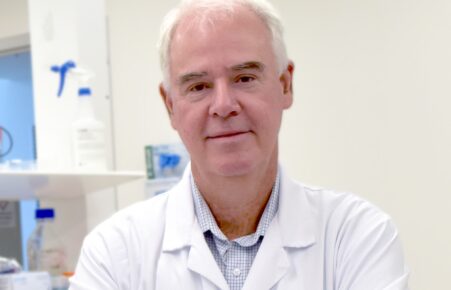
Professor Philip Hogg
Faculty
-
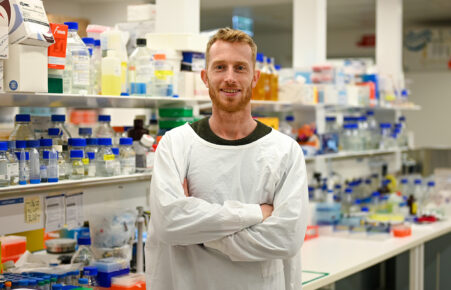
Dr Diego Butera
Postdoctoral Research Officer -
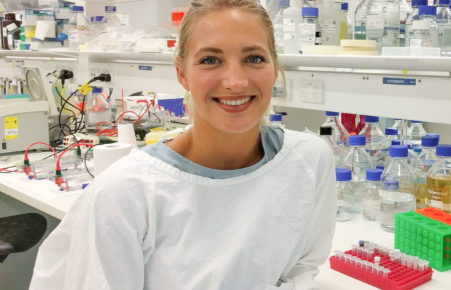
Dr Aster Pijning
Postdoctoral Research Officer -
Dr Mark Schreuder
Postdoctoral Research Officer -
Yolanda Tan
PhD Student -
Lu Sun
Visiting Scientist -
Karen Tran
PhD Student -
Ella Clancy
PhD Student

Student opportunities
Postgraduate students and postdoctoral scientists can work alongside international authorities on protein function and researchers who have successfully developed and commercialised their discoveries. To learn more about student opportunities in the Hogg lab and for all general enquiries relating to our work, please contact Professor Philip Hogg.