
Skip to content
Home page - Centenary Institute Centenary Institute

Primary menu

  • Research
        • Research

          The latest medical research into our most complex health challenges across biomedical AI, cancer, cardiovascular diseases, immunity, age-related, rare and infectious diseases.

          Learn more

        • Biomedical AI
        • Cancer Innovations
        • Cardiovascular Research
        • Infection & Immunity
        • Rare Diseases & Gene Therapy
        • Laboratories
        • Impact
        • Technologies
        • Commercialisation
  • Support us
        • Support us

          By supporting the Centenary Institute you can help improve human health through excellence in medical research.

          Learn more

        • Workplace giving
        • Host or join a fundraiser
        • Gift in your will
        • Donate in memory
        • Advise on our research
  • Careers & students
        • Careers & Students

          Postdoctoral and postgraduate students can work alongside world-leading medical researchers within state-of-the-art research facilities.

        • Careers
        • Study opportunities
  • News & events
        • News & Events

          Explore the latest research breakthroughs and ways you can take part in our series of digital and in-person events.

        • News
        • Statements
        • Events
        • Real stories
  • About us
        • About us

          We are world-leading independent medical research institute that drives collaboration to accelerate and translate solutions to our most complex health challenges.

          Learn more

        • Governance
        • Corporate information
        • Annual reports
        • Animals in research
        • Contact
  • Donate
    Centenary Institute > News > DPP9 enzyme role in cancer revealed

DPP9 enzyme role in cancer revealed

Date time 4 August, 2022
News Type News type Research News
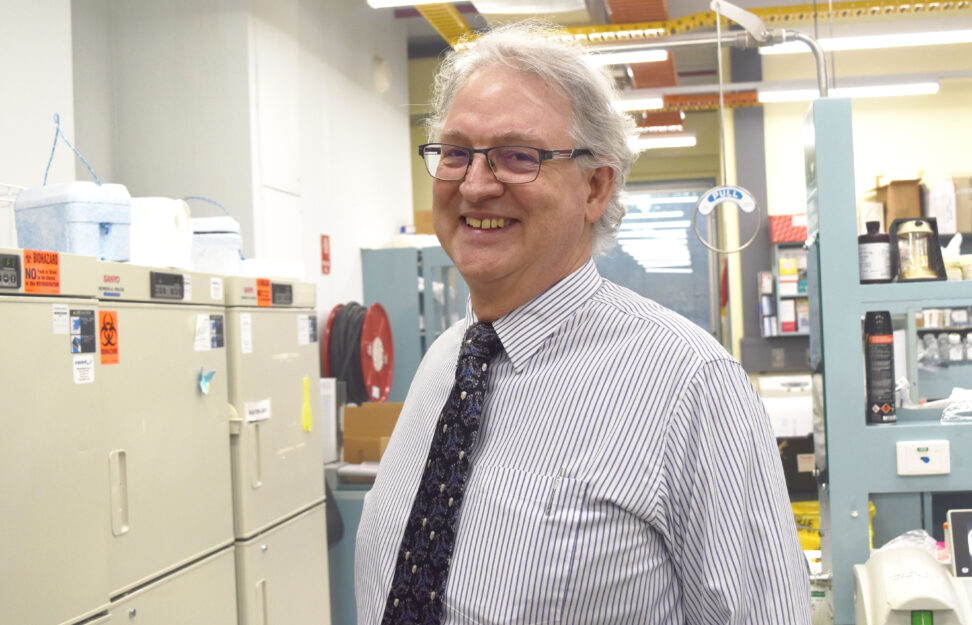
Professor Mark Gorrell
A new study from German and Centenary Institute researchers has provided new understanding of an enzyme called dipeptidyl peptidase 9 (DPP9) and its role in cancer development.

Published in the prestigious journal EMBO Reports, the researchers found that the DPP9 enzyme regulates a protein known as BRCA2, a well-known suppressor of tumour growth.

The finding suggests that targeting DPP9 could be an effective therapeutic approach to tackling cancer, the second leading cause of death globally.

“BRCA2 suppresses tumours by enhancing DNA repair,” said Professor Mark Gorrell, Head of the Liver Enzymes in Metabolism and Inflammation Program at the Centenary Institute and collaborating author on the research paper.

“Some tumours, such as breast cancer, grow because the BRCA2 protein inside a cell in our body is defective, thus causing insufficient DNA repair.”

“We were able to find proof that BRCA2 is regulated by the DPP9 enzyme. When we removed DPP9 from cells, DNA repair slowed down. This study supports our previous research that a DPP9 deficiency can increase the risk of a tumour starting.”

The flip side of this new discovery say the researchers’ is that inhibition of DPP9 may also be therapeutically useful for enhancing existing cancer therapies that disrupt DNA repair in tumours. Such cancer therapies include radiation therapy and the drug Olaparib.

“This research is important as it opens up a new field of understanding of a previously unknown fundamental role of DPP9 in cell function and disease,” said Professor Gorrell.

The international study was led by researchers from the University of Freiburg, Germany and the University Medical Center Göttingen, Germany.

Professor Gorrell and his group at the Centenary Institute first discovered the enzyme DPP9 in 1999.

[ENDS]

Publication: Dipeptidyl peptidase 9 triggers BRCA2 degradation and promotes DNA damage repair.
Themes

  • Cancer Innovations

    Cancer Innovations

People

  • Professor Mark Gorrell

    Faculty

Research Fields

  • Liver disease

Media enquires

For all media and interview enquiries, please contact Tony Crawshaw

Phone number Phone Number +61 402 770 403

Email Email t.crawshaw@centenary.org.au

Recent Stories

  • Centenary researchers aim to improve diagnosis of heavy menstrual bleeding

    The Centenary Institute is implementing a new research program aimed at improving the diagnosis and care of women experiencing heavy menstrual bleeding.
    News Type: Research News
    Date 21 May 2026
  • New insight into liver ‘cross-talk’ could help tackle fatty liver disease

    Researchers from the Centenary Institute and Tianjin Medical University have uncovered an important communication pathway inside the liver that helps control fat build-up, offering a promising new direction for tackling fatty liver disease.
    News Type: Research News
    Date 13 May 2026
  • Blood clotting protein’s hidden complexity revealed

    Researchers at the Centenary Institute have discovered that fibrinogen, a key blood clotting protein, is far more complex than previously understood, offering new insight into how blood clots form in the body.
    News Type: Research News
    Date 30 Apr 2026
  • Researcher spotlight: Dr Tracy Liu

    For Dr Xin (Tracy) Liu, fatty liver disease isn’t just a scientific challenge, it’s personal. Inspired by family members affected by metabolic conditions, she’s now a key member of Australia’s seven‑year Snow Program for Liver Health.
    News Type: Profiles
    Date 24 Apr 2026

Subscribe to receive news on
research updates and free events

Newsletter

The Centenary Institute is a world-leading independent Medical Research Institute.

We acknowledge the Gadigal of the Eora Nation, the traditional custodians of the Country on which the Centenary Institute stands.

About

  • About us
  • Governance
  • Corporate information

Research

  • Our researchers
  • News

Careers & studies

  • Career opportunities
  • Student opportunities
  • Life at Centenary

Links

  • Contact
  • Privacy statement
  • Staff Intranet

Contact us

Building 93, Royal Prince Alfred Hospital
Missenden Rd
Camperdown NSW 2050 Australia
Telephone +61 2 9565 6100
Fax +61 2 9565 6101

Contact Privacy

Centenary Institute ABN 22 654 201 090 (DGR 1) • Centenary Institute Medical Research Foundation ABN 85 778 244 012 (DGR 2)
© 2017 Centenary Institute of Cancer Medicine and Cell Biology.

  • Linkedin
  • Facebook
  • Twitter
  • Youtube
  • Instagram