
Skip to content
Home page - Centenary Institute Centenary Institute

Primary menu

  • Research
        • Research

          The latest medical research into our most complex health challenges across biomedical AI, cancer, cardiovascular diseases, immunity, age-related, rare and infectious diseases.

          Learn more

        • Biomedical AI
        • Cancer Innovations
        • Cardiovascular Research
        • Infection & Immunity
        • Rare Diseases & Gene Therapy
        • Laboratories
        • Impact
        • Technologies
        • Commercialisation
  • Support us
        • Support us

          By supporting the Centenary Institute you can help improve human health through excellence in medical research.

          Learn more

        • Workplace giving
        • Host or join a fundraiser
        • Gift in your will
        • Donate in memory
        • Advise on our research
  • Careers & students
        • Careers & Students

          Postdoctoral and postgraduate students can work alongside world-leading medical researchers within state-of-the-art research facilities.

        • Careers
        • Study opportunities
  • News & events
        • News & Events

          Explore the latest research breakthroughs and ways you can take part in our series of digital and in-person events.

        • News
        • Statements
        • Events
        • Real stories
  • About us
        • About us

          We are world-leading independent medical research institute that drives collaboration to accelerate and translate solutions to our most complex health challenges.

          Learn more

        • Governance
        • Corporate information
        • Annual reports
        • Animals in research
        • Contact
  • Donate
    Centenary Institute > News > New COVID-19 vaccine candidate shows strong protection against multiple variants

New COVID-19 vaccine candidate shows strong protection against multiple variants

Date time 18 July, 2025
News Type News type Media release
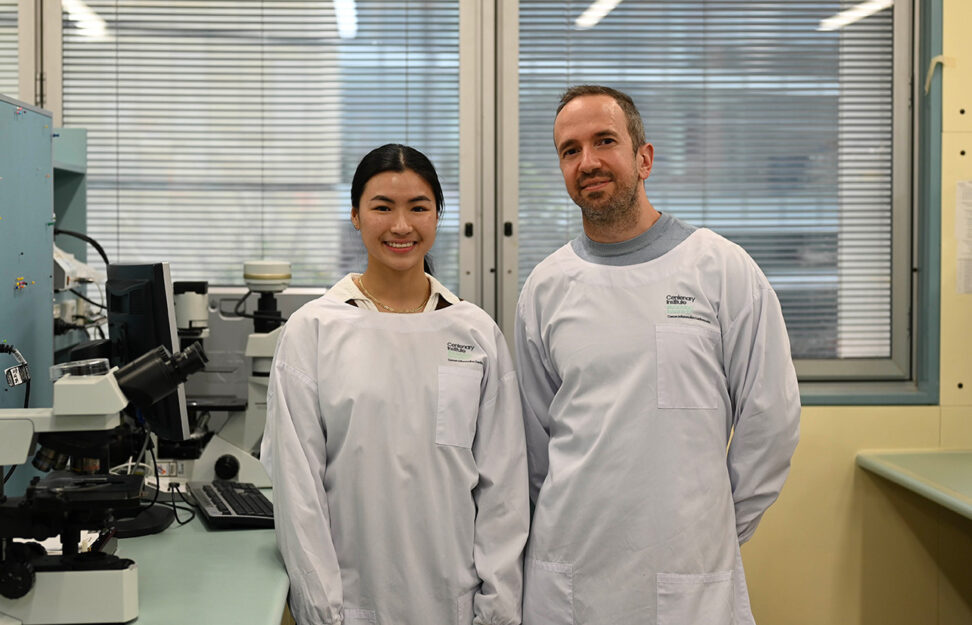
Elizabeth Chan and Dr Claudio Counoupas
A promising new COVID-19 vaccine candidate developed by researchers at the Centenary Institute and the University of Sydney has shown strong potential to protect against both current and emerging coronavirus variants. By targeting features shared by a range of coronaviruses, the vaccine is designed to offer broader and longer-lasting protection as the virus continues to evolve.

The development comes as Australia faces continued COVID-19 circulation during winter, with new Omicron subvariants such as XBB.1.5 contributing to infections and hospitalisations. To date, there have been over 115,000 COVID-19 cases reported to the Australian Government’s National Notifiable Diseases Surveillance System for 2025.

Published in the scientific journal npj Vaccines, the new study shows that the vaccine candidate, named CoVEXS5, protected mice from multiple coronaviruses, including the highly immune-evasive Omicron XBB.1.5 variant and SARS-CoV-1, a relative of SARS-CoV-2 that was responsible for the 2002–2004 SARS outbreak.

In laboratory tests, CoVEXS5 reduced virus levels in the lungs of infected mice by approximately 99.9% compared to unvaccinated controls, demonstrating a dramatic protective effect.

Notably, the vaccine candidate triggered high levels of virus-blocking antibodies and activated special immune T-cells in the lungs that play a key role in defending against respiratory viruses.

CoVEXS5 features a unique version of the spike protein, which fuses protein elements from several coronaviruses into a single structure. This fusion helps the immune system recognise and respond to a broader range of virus types, not just one specific strain.

“By combining parts of multiple coronaviruses, we’ve created a vaccine that can better prepare the body to fight off both current and future threats,” said Dr Claudio Counoupas, co-lead study author and researcher at the Centenary Institute’s Centre for Infection & Immunity.

Co-lead study author, Elizabeth Chan, a PhD student at the Centenary Institute and the University of Sydney, said the findings highlight the potential for a next-generation COVID-19 vaccine that could work across different variants.

“The immune response we saw in the laboratory was both strong and broad. It’s exciting to think that this approach could help future-proof vaccines against ongoing changes in the virus,” she said.

The vaccine candidate also includes Sepivac SWE, an open-access adjuvant that enhances the immune response and offers practical advantages for vaccine manufacturing and global distribution.

“Sepivac SWE is not only effective, but because it’s open-access, it can be used by manufacturers around the world without licensing barriers or high costs,” said senior study author, Professor Jamie Triccas, Deputy Director of the Sydney Infectious Diseases Institute at the University of Sydney.

“That’s a huge advantage for global vaccine equity, especially in low and middle-income countries where access and cost are critical concerns.”

The work was funded by the Coalition for Epidemic Preparedness Innovations, a global partnership focused on accelerating the development of vaccines against epidemic and pandemic threats, ensuring they are accessible to everyone who needs them.

The research team is now focused on advancing the vaccine candidate through further development and testing.
Media enquires

For all media and interview enquiries, please contact Tony Crawshaw

Phone number Phone Number +61 402 770 403

Email Email t.crawshaw@centenary.org.au

Media Release

New COVID-19 vaccine candidate shows strong protection against multiple variants

Download

Recent Stories

  • Genetic research sheds light on inherited arrhythmia syndromes

    Centenary Institute researchers have found that a rare genetic variant in the SCN5A gene disrupts the processing of genetic instructions, providing new evidence that it may contribute to inherited heart rhythm disorders.
    News Type: Research News
    Date 24 Nov 2026
  • Centenary researcher receives Heimburger Award

    Centenary Institute researcher Dr Aster Pijning, from the Centre for Cancer Innovations, has received a 2026 Professor Heimburger Award, which will support her research into why some people experience unexplained bleeding.
    News Type: Research News
    Date 11 Nov 2026
  • When Art Meets Science returns to Government House

    The Centenary Institute’s When Art Meets Science exhibition returned to Government House Sydney this year, as part of the Sydney Open program, giving visitors the opportunity to explore one of the city’s most iconic buildings while discovering the visual side of medical research. At the event, over 2,000 visitors viewed striking scientific images captured by ...
    News Type: Community
    Date 03 Nov 2026
  • New laboratories strengthen Centenary Institute research

    The Centenary Institute has established four new research laboratories, broadening its capabilities across the areas of infection and immunity, respiratory disease and biomedical artificial intelligence (AI).
    News Type: Media release
    Date 20 Oct 2026

Subscribe to receive news on
research updates and free events

Newsletter

The Centenary Institute is a world-leading independent Medical Research Institute.

We acknowledge the Gadigal of the Eora Nation, the traditional custodians of the Country on which the Centenary Institute stands.

About

  • About us
  • Governance
  • Corporate information

Research

  • Our researchers
  • News

Careers & studies

  • Career opportunities
  • Student opportunities
  • Life at Centenary

Links

  • Contact
  • Privacy statement
  • Staff Intranet

Contact us

Building 93, Royal Prince Alfred Hospital
Missenden Rd
Camperdown NSW 2050 Australia
Telephone +61 2 9565 6100
Fax +61 2 9565 6101

Contact Privacy

Centenary Institute ABN 22 654 201 090 (DGR 1) • Centenary Institute Medical Research Foundation ABN 85 778 244 012 (DGR 2)
© 2017 Centenary Institute of Cancer Medicine and Cell Biology.

  • Linkedin
  • Facebook
  • Twitter
  • Youtube
  • Instagram