
Skip to content
Home page - Centenary Institute Centenary Institute

Primary menu

  • Research
        • Research

          The latest medical research into our most complex health challenges across biomedical AI, cancer, cardiovascular diseases, immunity, age-related, rare and infectious diseases.

          Learn more

        • Biomedical AI
        • Cancer Innovations
        • Cardiovascular Research
        • Healthy Ageing
        • Infection & Immunity
        • Rare Diseases & Gene Therapy
        • Laboratories
        • Impact
        • Technologies
        • Commercialisation
  • Support us
        • Support us

          By supporting the Centenary Institute you can help improve human health through excellence in medical research.

          Learn more

        • Workplace giving
        • Host or join a fundraiser
        • Gift in your will
        • Donate in memory
        • Advise on our research
  • Careers & students
        • Careers & Students

          Postdoctoral and postgraduate students can work alongside world-leading medical researchers within state-of-the-art research facilities.

        • Careers
        • Study opportunities
  • News & events
        • News & Events

          Explore the latest research breakthroughs and ways you can take part in our series of digital and in-person events.

        • News
        • Statements
        • Events
        • Real stories
  • About us
        • About us

          We are world-leading independent medical research institute that drives collaboration to accelerate and translate solutions to our most complex health challenges.

          Learn more

        • Governance
        • Corporate information
        • Annual reports
        • Animals in research
        • Contact
  • Donate
    Centenary Institute > News > New route into cells could make gene therapies safer

New route into cells could make gene therapies safer

Date time 15 July, 2025
News Type News type Media release
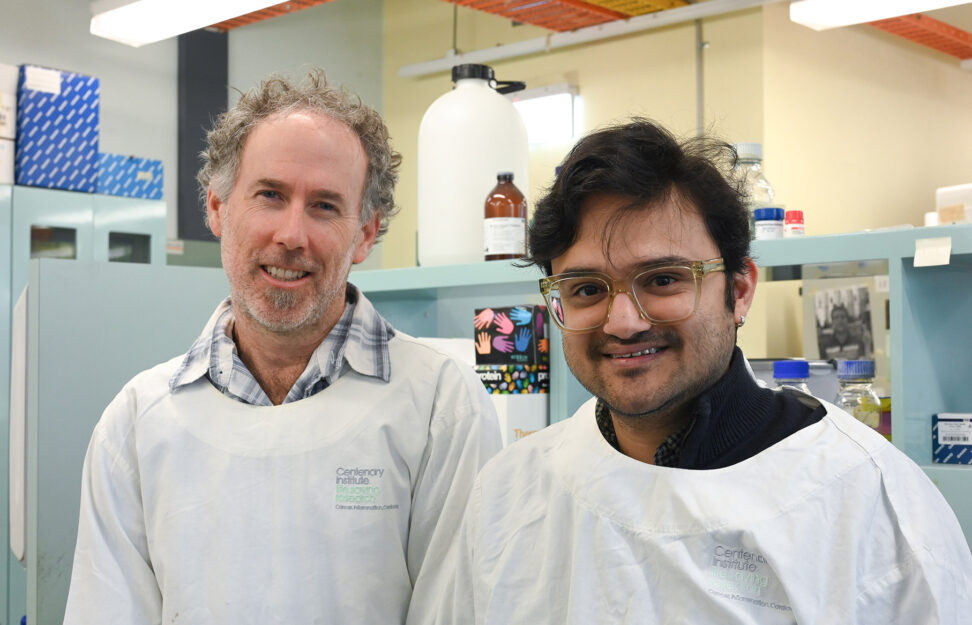
Dr Chuck (Charles) Bailey and Dr Bijay Dhungel
Scientists from the Centenary Institute and the University of Sydney have made a landmark discovery that could lead to safer and more effective gene therapies for a range of serious genetic disorders including Duchenne muscular dystrophy, Pompe disease and haemophilia.

Published in the leading journal Cell, the study identifies a previously unknown gateway into human cells, a receptor called AAVR2, that gene therapy viruses use to deliver therapeutic genes. This newly uncovered pathway could allow lower doses of virus to be used in treatment, helping to reduce side effects and treatment costs, while improving patient outcomes.

Gene therapies typically use modified viruses, known as adeno-associated viruses (AAVs), to deliver healthy genes into the body. These treatments have the potential to be life-changing for patients, their families and caregivers. However, they frequently require high vector doses to achieve therapeutic effects which in some cases can trigger severe immune responses, lead to serious complications, or even death.

“We found that certain AAV types can use this newly identified receptor, AAVR2, to enter cells, providing an alternative to the previously known entry route,” said Dr Bijay Dhungel, lead author of the study and researcher at the Centenary Institute’s Centre for Rare Diseases & Gene Therapy and the University of Sydney.

“This discovery uncovers a completely new pathway for delivering genes into cells. Modulating this pathway can potentially make gene therapies safer, cheaper and more precise,” he said.

Using advanced genetic, biochemistry and molecular biology techniques, the researchers showed that AAVR2 plays a crucial role in helping several AAV types, including those widely used in patients, enter cells more efficiently.

“We not only identified this new receptor AAVR2 but also discovered how it binds to the viruses that deliver the genes,” said co-senior author Dr Charles (Chuck) Bailey, Head of the Centre for Rare Diseases & Gene Therapy at the Centenary Institute and researcher at the University of Sydney.

“We then went a step further and engineered a miniature version of the receptor and demonstrated that this significantly enhances how efficiently the gene therapy is taken up in human cells and tissues. We believe this knowledge will ultimately improve the accessibility of gene therapies to patients.”

The researchers say the findings have important implications for the future of gene therapy, offering new strategies to tailor treatments, lower required doses and potentially avoid immune-related complications that have limited some current approaches.

The discovery also advances scientific understanding of how therapeutic viruses interact with human cells. This is essential knowledge for developing the next-generation of safe, effective and precision-guided gene therapies.

The study was supported by funding from NSW Health, National Health and Medical Research Council (NHMRC), Therapeutic Innovation Australia, Tour de Cure, Cure the Future and Brandon Capital CUREator.
People

  • Associate Professor Charles Bailey

    Head, Centre for Rare Diseases & Gene Therapy

Media enquires

For all media and interview enquiries, please contact Tony Crawshaw

Phone number Phone Number +61 402 770 403

Email Email t.crawshaw@centenary.org.au

Media Release

New route into cells could make gene therapies safer

Download

Recent Stories

  • New grant targets longer-lasting islet cell treatments for type 1 diabetes

    Dr Lise Hunault, a researcher in the Centenary Institute’s Centre for Biomedical AI, has been awarded a major research grant from Breakthrough T1D, the leading global type 1 diabetes research and advocacy organisation, to advance islet-cell replacement therapies for type 1 diabetes.
    News Type: Research News
    Date 16 Mar 2026
  • Centenary marks International Women’s Day with inspiring speakers

    The Centenary Institute community came together to celebrate International Women’s Day 2026, with a special event highlighting this year’s Australian theme, ‘Balancing the Scales.’
    News Type: Community
    Date 11 Mar 2026
  • Vaxosome launched to develop next-generation mRNA vaccines

    A new biotechnology company, Vaxosome, has been launched to develop next-generation vaccines aimed at tackling some of the world’s most challenging infectious diseases.
    News Type: Research News
    Date 10 Mar 2026
  • Centenary partners in transformative national liver health program

    The Snow Medical Research Foundation has today announced major long-term funding of $15.5 million for a new national research program targeting fatty liver disease, a condition that affects up to one in three Australians. The Centenary Institute will play a key role in the collaborative effort.
    News Type: Research News
    Date 05 Mar 2026

Subscribe to receive news on
research updates and free events

Newsletter

The Centenary Institute is a world-leading independent Medical Research Institute.

We acknowledge the Gadigal of the Eora Nation, the traditional custodians of the Country on which the Centenary Institute stands.

About

  • About us
  • Governance
  • Corporate information

Research

  • Our researchers
  • News

Careers & studies

  • Career opportunities
  • Student opportunities
  • Life at Centenary

Links

  • Contact
  • Privacy statement
  • Staff Intranet

Contact us

Building 93, Royal Prince Alfred Hospital
Missenden Rd
Camperdown NSW 2050 Australia
Telephone +61 2 9565 6100
Fax +61 2 9565 6101

Contact Privacy

Centenary Institute ABN 22 654 201 090 (DGR 1) • Centenary Institute Medical Research Foundation ABN 85 778 244 012 (DGR 2)
© 2017 Centenary Institute of Cancer Medicine and Cell Biology.

  • Linkedin
  • Facebook
  • Twitter
  • Youtube
  • Instagram